-
Shop
- Adidas
- Advanced Technologies
- AI Skills Mastery 2026 Collection
- Best-Sellers
- Car Accessories
- Dating & Social Skills
- Digital Resources
- AI Skills
- Beauty
- Budgeting & Saving
- Car Buying & Ownership
- Cozy Feast Collection
- Electronics & Technology
- Entrepreneurship & Business Growth
- Financial Education
- Financial Independence
- Financial Mindset & Psychology
- Goal Setting
- Hobbies
- Home Styling & Organization
- Leadership
- Mindfulness
- Mindset
- Parenting & Child Development
- Personal Style & Fashion
- Pet Lifestyle & Wellness
- Positive Thinking
- Sleep Improvement
- Smart Life with AI
- Stress Management & Relaxation
- Travel Planning
- Yoga & Fitness
- Yoga & Mind-Body Practices
- Education & Learning
- Family & Parenting
- Fashion
- Furniture
- Gadgets
- Health & Beauty
- Health & Wellness
- Home & Garden
- Jewelry
- Kids & Babies
- Kitchen
- Kitchen Best-Sellers
- Nike
- Patio, Lawn & Garden
- Personal Growth
- Pet Care
- Pet Supplies
- Pets
- Sport & Outdoors
- Travel
- Wealth
- YouTube Shorts Best-Sellers
- Popular
- Best deals
Montessori Wooden Arithmetic Board for Ages 3–7
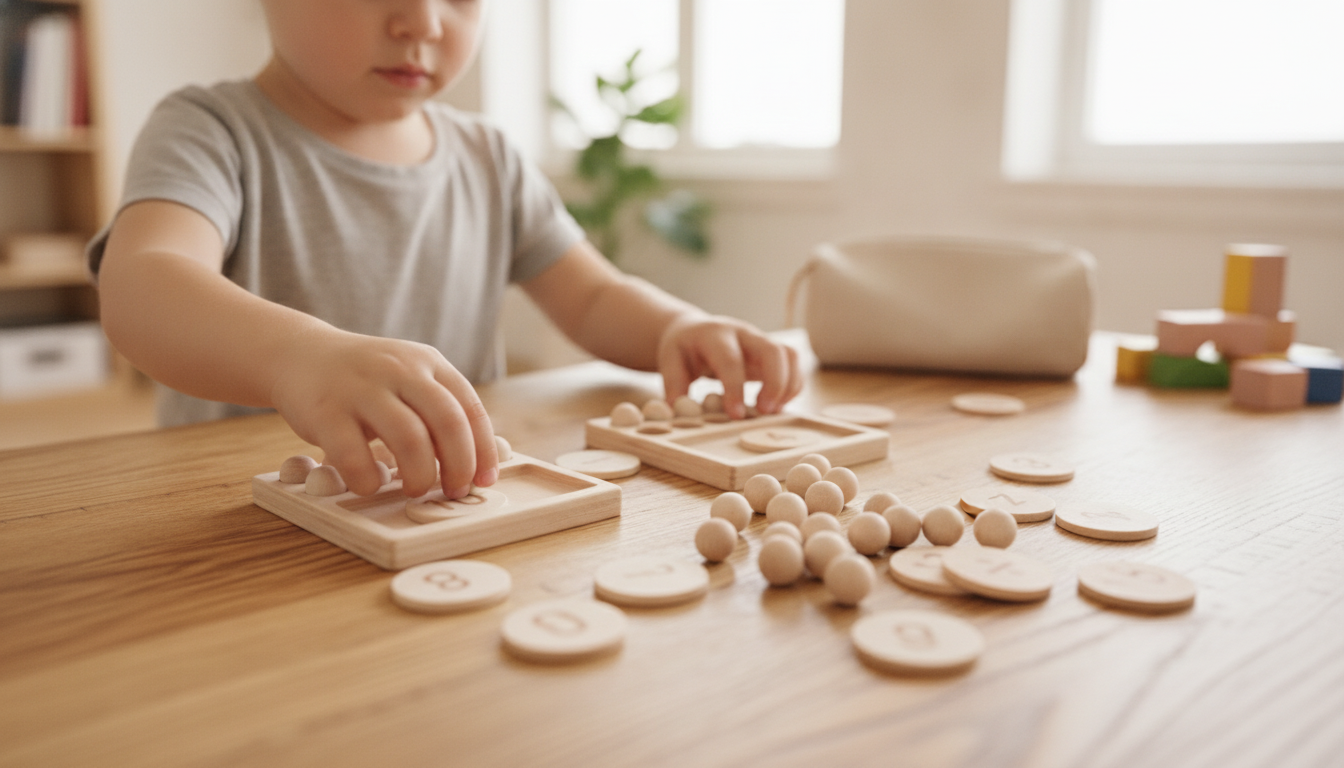
Montessori Wooden Arithmetic Board: Hands-On Number Skills for Early Learners
A wooden arithmetic board supports early math through touch, movement, and clear visual structure. With number tiles and symbols, it helps children practice counting, simple equations, and number recognition in a calm, self-correcting way. Because the child can physically build a sequence or an equation, math becomes something they can see and fix on their own—an approach that fits well with play-based, developmentally appropriate learning. For more guidance, see How Montessori Math Builds Strong Foundations.
Many families find this kind of material especially helpful for short, focused practice that doesn’t rely on worksheets. For more on why hands-on play matters in early childhood, see the American Academy of Pediatrics’ overview of The Power of Play, and NAEYC’s guidance on Developmentally Appropriate Practice. For further reading, see Montessori Basics: How Math Progresses Through the Levels.
What a Wooden Arithmetic Board Helps Children Learn
- Number recognition and sequencing (matching symbols to quantities and order)
- Counting practice and one-to-one correspondence using pieces placed in slots or spaces
- Early operations: simple addition and subtraction with visible equation building
- Patterning and logical thinking through repeated, structured tasks
- Focus and fine-motor coordination from grasping, placing, and aligning pieces
In Montessori-style work, repetition is a feature, not a flaw. The board gives a clear “job” to do—build the number line, match the quantity, complete the equation—so children can settle into a predictable rhythm. If you’d like background on the approach, Britannica’s summary of the Montessori method of education is a helpful starting point.
Key Pieces and How They’re Typically Used
- Number tiles: used to build number lines, compare values, and form equations
- Operation symbols (+, −, ×, ÷): introduced gradually once number sense is steady
- Equation layout: children construct problems physically, then read them aloud
- Self-check habits: child verifies alignment, order, and completeness without heavy adult correction
- Progression: start with counting and matching, then move toward simple story problems
A practical way to introduce the board is to model once—slowly—and then let the child take over. When the child misplaces a tile, the material itself often “tells” them something is off (a gap in the sequence, a missing number, or an equation that can’t be read correctly). That built-in feedback supports confidence while reducing constant adult intervention.
Age Range and Skill Progression
- Ages 3–4: recognize numerals, count objects, match quantities to numbers, practice left-to-right sequencing
- Ages 4–5: build simple addition/subtraction sentences with small numbers; explore “more/less”
- Ages 5–7: practice larger numbers, repeated addition concepts, and early multiplication ideas (as readiness allows)
- Signs of readiness: steady counting, interest in “how many,” and ability to focus for short work cycles
- Avoid rushing: the board works best when each step feels easy and repeatable
Example Progression Activities
| Level | Goal | Activity idea | Adult role |
|---|---|---|---|
| Beginner | Number recognition | Lay out 1–10 in order; mix tiles and have the child rebuild the sequence | Name numbers clearly; let the child do the rebuilding |
| Early practice | Counting & matching | Place a number tile, then count out matching objects (buttons, beads) beside it | Provide objects; ask simple prompts (“How many?”) |
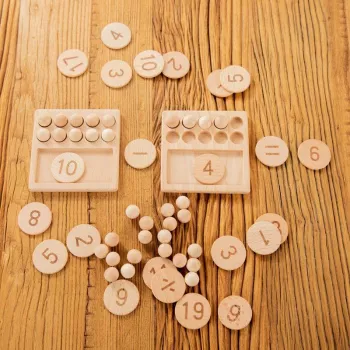
| Developing | Addition & subtraction | Build 3 + 2 = 5 using tiles; read the equation aloud together | Model once; then step back and observe |
| Extension | Simple word problems | Act out a short scenario (“You have 4 apples, you get 1 more…”) and build it on the board | Keep language concrete; encourage the child to explain |
How to Set Up a Calm, Independent Work Routine
- Choose a consistent workspace with good lighting and minimal distractions.
- Present the material: place the board and pieces neatly, then demonstrate one slow example.
- Use short work cycles (5–15 minutes), ending while engagement is still positive.
- Rotate difficulty: alternate easy “confidence tasks” with one small new challenge.
- Store pieces predictably to support independence and reduce missing parts.
If frustration shows up, it’s often a sign the step is too big, not that the child “isn’t a math kid.” Go back to a simpler task (like rebuilding 1–10), keep language minimal, and let the hands do most of the work. Over time, children tend to move from “placing tiles” to actually thinking in number relationships—more/less, before/after, and eventually combining and separating quantities.
Choosing a Good Board for Home Use
Montessori Wooden Arithmetic Board (Product Details)
The Montessori Wooden Arithmetic Board is designed for hands-on practice with early math skills using a tactile, visual layout. It’s useful for counting, number sequencing, and forming simple equations with tiles and symbols, making it a strong option for quiet, repeatable practice sessions at home or in a classroom corner. It’s also a budget-friendly way to build a consistent math routine without relying on screens or worksheets.
More In-Stock Picks
- Calvin Klein Jeans Women’s Black and Pink Printed Shoulder Bag
- Luxury Knitted Dog Sweater Soft Winter Pet Coat for Small Dogs & Cats
FAQ
What age is a wooden arithmetic board best for?
Most children use a wooden arithmetic board well from about ages 3–7, depending on readiness. A good starting point is steady counting and numeral recognition; operations like addition and subtraction typically come after those basics feel easy.
How can a child use an arithmetic board without getting frustrated?
Keep sessions short (5–15 minutes) and start with simple sequencing or matching tasks that the child can complete successfully. Demonstrate one example slowly, keep pieces organized, and allow time for self-correction before stepping in.
Is a wooden arithmetic board safe for preschoolers?
It can be safe with supervision and a board that has smooth edges and non-toxic finishes. For younger preschoolers, pay close attention to piece size and mouthing behavior to reduce choking risk.
Recommended for you

Stay-at-Home Mom Burnout Reset: Refill Your Cup
Jul 4, 2026













Leave a comment