-
Shop
- Adidas
- Advanced Technologies
- AI Skills Mastery 2026 Collection
- Best-Sellers
- Car Accessories
- Dating & Social Skills
- Digital Resources
- AI Skills
- Beauty
- Budgeting & Saving
- Car Buying & Ownership
- Cozy Feast Collection
- Electronics & Technology
- Entrepreneurship & Business Growth
- Financial Education
- Financial Independence
- Financial Mindset & Psychology
- Goal Setting
- Hobbies
- Home Styling & Organization
- Leadership
- Mindfulness
- Mindset
- Parenting & Child Development
- Personal Style & Fashion
- Pet Lifestyle & Wellness
- Positive Thinking
- Sleep Improvement
- Smart Life with AI
- Stress Management & Relaxation
- Travel Planning
- Yoga & Fitness
- Yoga & Mind-Body Practices
- Education & Learning
- Family & Parenting
- Fashion
- Furniture
- Gadgets
- Health & Beauty
- Health & Wellness
- Home & Garden
- Jewelry
- Kids & Babies
- Kitchen
- Kitchen Best-Sellers
- Nike
- Patio, Lawn & Garden
- Personal Growth
- Pet Care
- Pet Supplies
- Pets
- Sport & Outdoors
- Travel
- Wealth
- YouTube Shorts Best-Sellers
- Popular
- Best deals
The Long-Game Mindset: Systems for Success & Resilience

The Long-Game Mindset: Building Long-Term Success, Sustainable Growth, and Resilience
Quick wins can feel motivating, but they often collapse under stress, inconsistency, or unrealistic timelines. A long-game mindset is a practical way to keep momentum when progress is slow, results are delayed, and life gets messy. It combines clear direction, repeatable habits, and emotional resilience so goals can survive setbacks and still compound over time.
What the long-game mindset is (and what it isn’t)
A long-game mindset prioritizes compounding progress, patience, and durable systems over short bursts of effort. It asks a simple question: “Will this still work when motivation dips, the calendar gets crowded, or a setback hits?”
It isn’t the same as “moving slowly.” You can move fast—training hard, shipping projects, learning aggressively—while still making decisions that are sustainable and low on unnecessary downside risk. It also isn’t “toxic positivity.” Difficulty is expected; setbacks become data, not proof that you’re broken or behind.
When it’s working, the outcomes are practical: steadier execution, faster recovery after disruptions, and fewer cycles of burnout and restart.
Short-term thinking vs long-game thinking
| Situation | Short-term default | Long-game default | Better result over time |
|---|---|---|---|
| Motivation drops | Wait for inspiration | Follow a minimum baseline habit | Consistency stays intact |
| A setback happens | Quit or overcorrect | Review, adjust, and continue | Faster recovery |
| New opportunity appears | Say yes impulsively | Check fit with current priorities | Less distraction |
| Progress feels slow | Change the plan weekly | Measure leading indicators weekly | Compounding improvements |
| Workload increases | Push harder until burnout | Protect sleep, focus blocks, and rest | Sustainable performance |
The three pillars: success, sustainable growth, resilience
Long-term success is less about a single breakthrough and more about repeatable outputs: skills you can apply, relationships you maintain, and assets you keep building. Outcomes matter, but durable inputs keep producing outcomes.
Sustainable growth means increasing capacity without sacrificing health, values, or stability. If growth disappears the moment life gets stressful, it was closer to a sprint than a system.
Resilience is the ability to return to baseline after disruption. It’s trainable through planned challenges and recovery routines—much like physical conditioning. For a helpful overview of what resilience looks like in practice, see the American Psychological Association’s guide on resilience.
A useful rule: optimize for what can be repeated for 2 years, not what can be forced for 2 weeks.
Set a direction that survives mood swings
Motivation is weather; direction is climate. When mood swings show up, a long-game plan still holds.
- Clarify a north star statement: 1–2 sentences describing the kind of person being built and the impact being created.
- Translate goals into inputs: schedule actions you can control—writing sessions, workouts, outreach, study blocks.
- Use layered time horizons: 12 weeks for focus, 1 year for strategy, and 3 years for patience so daily noise doesn’t rewrite the plan.
- Define “enough” in each area: a minimum standard for work, health, and learning that prevents overcommitment and keeps recovery possible.
This is where many people get unstuck: goals become less emotional and more operational. You stop negotiating with yourself every day.
Build systems that make progress automatic
Consistency doesn’t come from intensity—it comes from reducing friction. Habit research also suggests automaticity builds over time through repetition and stable cues (see the National Library of Medicine overview on habit formation).
- Design a baseline routine: the smallest version of the habit that still counts on bad days (10 minutes, 1 page, 1 set).
- Use environment design: remove friction for good habits (prepared workspace) and add friction for distractions (logged-out apps, blocked sites).
- Track leading indicators: hours practiced, reps completed, outreach attempts, pages written—metrics that precede results.
- Create feedback loops: a weekly review (what worked/what didn’t/next adjustment) and a monthly reset (priorities, calendar, energy).
Small tools can help the environment do more of the work. For example, Magnetic Hooks can be a simple way to keep essentials visible—keys, headphones, a gym band, a checklist—so your baseline habit is easier to start.
Train resilience: how to bounce back without losing momentum
Resilience isn’t pretending things are fine; it’s keeping the next step small and doable when things aren’t. It also improves when recovery is treated as a skill, not a reward.
Even simple gratitude practices can support well-being and stress recovery when used consistently. Stanford Medicine summarizes practical benefits and mechanisms in its overview of the science of gratitude.
A simple 7-day reset to restart the long game
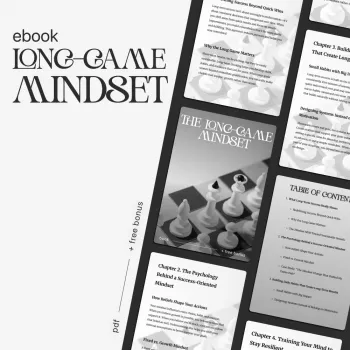
A guided option: The Long-Game Mindset ebook
If a structured approach helps more than piecing things together, The Long-Game Mindset ebook is designed to support long-term success, sustainable growth, and resilience with a clear framework and practical exercises.
If long-term goals include business or investing outcomes, Mastering Real Estate Success Guide can complement the mindset work by helping keep strategy and execution organized over longer time horizons.
FAQ
How long does it take to build a long-game mindset?
Shifts can start immediately, but they stabilize through repeated actions. A 2–4 week baseline habit builds traction, and a 12-week cycle is often enough to see measurable changes in consistency and recovery after setbacks.
What should be tracked to stay consistent when results are slow?
Track leading indicators: time spent, reps completed, sessions finished, outreach attempts, or pages written. A simple weekly review plus a streak or checklist keeps attention on controllable inputs instead of only outcomes.
How can resilience improve without pushing to burnout?
Use a stress budget: protect sleep, movement, and nutrition first, then scale effort to what’s sustainable. Minimum baseline habits and planned deload/rest periods let you keep momentum while giving your nervous system time to recover.















Leave a comment