-
Shop
- Adidas
- Advanced Technologies
- AI Skills Mastery 2026 Collection
- Best-Sellers
- Car Accessories
- Dating & Social Skills
- Digital Resources
- AI Skills
- Beauty
- Budgeting & Saving
- Car Buying & Ownership
- Cozy Feast Collection
- Electronics & Technology
- Entrepreneurship & Business Growth
- Financial Education
- Financial Independence
- Financial Mindset & Psychology
- Goal Setting
- Hobbies
- Home Styling & Organization
- Leadership
- Mindfulness
- Mindset
- Parenting & Child Development
- Personal Style & Fashion
- Pet Lifestyle & Wellness
- Positive Thinking
- Sleep Improvement
- Smart Life with AI
- Stress Management & Relaxation
- Travel Planning
- Yoga & Fitness
- Yoga & Mind-Body Practices
- Education & Learning
- Family & Parenting
- Fashion
- Furniture
- Gadgets
- Health & Beauty
- Health & Wellness
- Home & Garden
- Jewelry
- Kids & Babies
- Kitchen
- Kitchen Best-Sellers
- Nike
- Patio, Lawn & Garden
- Personal Growth
- Pet Care
- Pet Supplies
- Pets
- Sport & Outdoors
- Travel
- Wealth
- YouTube Shorts Best-Sellers
- Popular
- Best deals
AI Sleep Check-Ins: Daily Notes to Improve Your Rest

AI-Guided Sleep Check-Ins: Track Patterns and Improve Rest With Simple Daily Notes
Better rest often comes from noticing small patterns—timing, light, caffeine, stress, and routines. An AI assistant can help turn quick daily check-ins into clear trends and practical next steps, without needing complicated tracking devices. With a few consistent notes each day, you can move from “I slept badly” to “I sleep worse when my wake time shifts and I drink coffee after lunch,” then test simple adjustments that fit real life.
What an AI assistant can (and can’t) do for sleep improvement
Sleep can feel mysterious because the causes are usually small and cumulative. A structured check-in makes the invisible visible, and AI can help organize what you capture.
- Translate short daily notes into consistent, comparable entries (bedtime, wake time, awakenings, naps, caffeine, exercise, mood).
- Spot correlations over time (late caffeine and longer time to fall asleep, irregular wake times and daytime sleepiness).
- Suggest low-risk experiments based on sleep hygiene basics (schedule consistency, light exposure, winding down).
- Cannot diagnose sleep disorders; persistent snoring, breathing pauses, severe insomnia, or excessive daytime sleepiness warrant clinical evaluation.
For evidence-based basics on healthy sleep habits, the National Heart, Lung, and Blood Institute and the CDC offer practical, clinician-aligned guidance. Pairing those fundamentals with your own data is often where progress becomes clearer.
Set up a simple nightly check-in that stays consistent
The best sleep log is the one you can keep doing. Choose a format that feels frictionless: a notes app, a spreadsheet, or a guided workbook. Record at the same time each day—morning tends to work well because details are fresher and you’re less likely to skip it after a tiring day.
- Pick one place to log (notes app, spreadsheet, or a guided digital workbook) and one daily time to record (morning is often easiest for recall).
- Define a small set of fields to avoid burnout; add detail only after the habit is stable.
- Use the same rating scales every day (0–10 sleep quality, 0–10 stress) to keep trends reliable.
- Keep objective times separate from subjective ratings (e.g., actual bedtime vs. “felt sleepy”).
Daily sleep check-in template
| Field | Example entry | Why it matters |
|---|---|---|
| Bedtime / Lights out | 11:20 pm / 11:35 pm | Helps compare schedule consistency and wind-down duration |
| Estimated time to fall asleep | 25 minutes | Tracks sleep onset difficulty over time |
| Night awakenings | 2 (10 min total) | Highlights fragmentation and potential triggers |
| Wake time / Out of bed | 7:05 am / 7:20 am | Anchors the day and supports stable circadian rhythm |
| Total naps | 0 / 20 min at 3 pm | Can affect sleep pressure at night |
| Caffeine (last intake time) | 2 cups; last at 1:30 pm | Late use may delay sleep for some people |
| Alcohol (timing) | 1 drink at 8 pm | May worsen sleep continuity even if it feels sedating |
| Exercise (timing/intensity) | 30 min brisk walk at 6 pm | Can improve sleep; timing may matter for sensitivity |
| Light exposure (morning/evening) | 10 min morning sun; screens after 10 pm | Light cues influence circadian timing |
| Sleep quality (0–10) + note | 6/10; restless | Captures experience not shown by time alone |
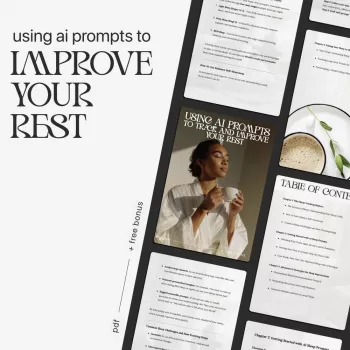
If you want structure without building your own system, a guided option like Using AI Prompts to Track and Improve Your Rest can keep the daily questions consistent while making weekly reviews easier to repeat.
Turn daily notes into weekly insights (without overreacting to one night)
One rough night doesn’t mean anything is “broken.” The value shows up when you look at clusters of nights and compare them to your routine.
- Review in 7-day blocks to smooth out normal variability; aim for trends, not perfection.
- Ask the AI assistant to summarize: average sleep duration, average time to fall asleep, most common wake-up triggers, best nights and what preceded them.
- Create a “top 3 levers” list (schedule, caffeine timing, evening routine) and focus on one lever at a time for 1–2 weeks.
- Flag red patterns: frequent long awakenings, very short sleep duration, or escalating anxiety around sleep.
Run small, safe experiments that support deeper sleep
If you’re not sure where to begin, use your log to pick the most repeatable lever. For many people, it’s a steadier wake time plus an earlier last caffeine. If you want deeper education on sleep stages and common disruptors, the American Academy of Sleep Medicine’s Sleep Education site is a strong, patient-friendly resource.
Use an AI assistant for reflection, not rumination
A guided workbook option for structured tracking
For a ready-to-use approach, consider Using AI Prompts to Track and Improve Your Rest. If you prefer keeping your sleep notes and essentials in one place while traveling or commuting, options like the Genuine Leather Women’s Crossbody Shoulder Bag – Minimalist Luxury Style or Calvin Klein Jeans Women’s Black and Pink Printed Shoulder Bag can make it easier to stick with the habit away from home.
When to get medical advice
FAQ
How long does it take to see meaningful sleep trends?
Many people see early patterns in 1–2 weeks, especially around wake-time consistency, caffeine timing, and late-night light exposure. Stronger signals usually show up with 4–6 weeks of consistent notes and weekly review.
What should be tracked if the routine feels overwhelming?
Keep it minimal: bedtime, wake time, estimated time to fall asleep, awakenings, naps, caffeine/alcohol timing, and a simple 0–10 sleep quality rating. You can add stress, exercise, or light exposure later once the habit is stable.
Is it safe to follow AI-generated sleep suggestions?
It’s generally safe to use AI for low-risk sleep hygiene steps like steady wake times, earlier caffeine cutoffs, and a calmer wind-down routine. Avoid drastic changes and seek professional guidance if you have symptoms of a sleep disorder or severe, persistent insomnia.













Leave a comment